Over the past two decades, millions of pounds have been invested in booking platforms, reservation management software, table allocation systems and no-show reduction tools. Restaurants can now manage availability in real time, accept online reservations 24 hours a day and automate much of the booking process.
There's just one problem. None of these systems actually creates demand. They organise demand that already exists. A customer visits a website, searches for a restaurant, decides where they want to eat and makes a booking. The reservation platform simply facilitates the transaction.
- But what about the customer who wasn't planning to visit?
- What about the office worker leaving work and deciding where to eat on the train home?
- What about the couple strolling through town looking for somewhere appealing?
- What about the family finishing a day of shopping and looking for dinner?
These diners make up a significant part of hospitality revenue, yet they remain largely invisible to the industry's technology stack.
For many restaurants, a substantial proportion of covers arrive without a reservation. They are impulse decisions, spontaneous choices and last-minute opportunities. They walk through the door, enjoy a meal, pay the bill and leave.
- In many cases, no customer profile is created.
- No email address is captured.
- No phone number is collected.
- No future marketing opportunity exists.
- The relationship begins and ends with the transaction.
This creates a huge blind spot for restaurants. Operators know how many reservations they receive. They know which channels generated those bookings. They can analyse occupancy, booking patterns and customer behaviour. Yet a large proportion of their revenue often comes from customers they know almost nothing about.
The irony is that these spontaneous diners may represent one of the biggest growth opportunities in hospitality. While the industry has focused heavily on managing reservations, relatively little attention has been given to generating new demand and converting nearby consumers into customers.
This is where the conversation needs to change. The future of hospitality may not be about managing bookings more efficiently. It may be about creating bookings, visits and walk-ins that otherwise would never have happened at all. Because restaurants don't ultimately need reservation systems.
They need customers. And there is a very important difference between the two.
Why Just Ten Additional Covers Per Week Can Change Everything
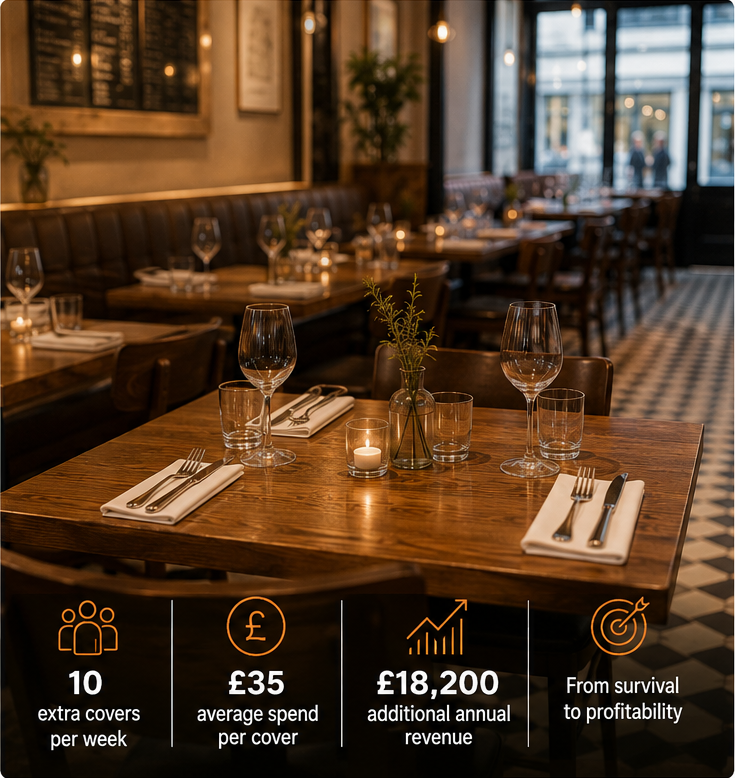
Small Numbers. Big Impact. A handful of additional covers each week can have a meaningful impact on restaurant profitability. The fixed costs have already been incurred. Every additional diner helps make better use of existing capacity while generating incremental revenue.
Restaurant growth is often discussed in dramatic terms.
- More locations.
- More staff.
- More marketing.
- More investment.
In reality, many hospitality businesses don't need transformational change to improve their fortunes. They simply need a few more customers.
Let's assume a restaurant generates an average spend of £35 per cover. If that venue attracts just ten additional covers per week, that's an extra £350 in weekly revenue. Over a year, that's £18,200 before drinks, desserts, repeat visits or referrals are taken into account.
For some restaurants, that may represent the difference between breaking even and generating a healthy profit. The opportunity becomes even more compelling when you consider that most of the fixed costs have already been incurred.
- The rent is already being paid.
- The lights are already on.
- The kitchen is already staffed.
- The tables are already there.
Those additional covers often arrive at a much lower acquisition cost than many operators realise because they utilise capacity that already exists. This is why occupancy matters so much. An empty table generates nothing. A table occupied by just a handful of additional diners each week can generate thousands of pounds in annual revenue.
The challenge isn't necessarily finding hundreds of new customers. It's finding the right customers at the right time.
- Customers who are already nearby.
- Customers who are already looking for somewhere to eat.
- Customers who simply need a reason to choose one restaurant over another.
For decades, hospitality technology has focused on managing bookings. The next opportunity may be helping restaurants generate those additional covers in the first place. Because sometimes the difference between survival and profitability isn't hundreds of customers. It's ten.
Restaurants Don't Have A Booking Problem. They Have A Demand Problem
For years, the hospitality industry has treated reservations as the solution. In reality, reservations are simply a way of organising customers who have already decided to visit. The booking itself isn't the achievement. The customer is. That's an important distinction because it changes how we think about growth.
A restaurant with empty tables rarely has a booking problem. It has a demand problem. The venue may already be listed on booking platforms. It may have a website. It may have social media channels. It may even have excellent reviews and a loyal customer base. But if customers aren't actively searching for a reservation, none of those tools creates demand on their own. They simply help process it once it exists.
This is where much of the hospitality industry has focused its attention for the past twenty years.
- Making reservations easier.
- Managing tables more efficiently.
- Reducing no-shows.
- Improving booking workflows.
All worthwhile goals. But they address what happens after a customer has decided to dine. They do very little to influence the customer who hasn't yet made that decision.
Consider a busy high street on a Thursday evening. Hundreds of people may walk past restaurants. Some are heading home from work. Others are shopping, socialising or looking for somewhere to eat. Many haven't decided where they will dine. Some haven't even decided whether they will dine out at all. This is where the greatest opportunity exists.
Not in managing demand that has already formed. But in creating demand that otherwise may never have existed. The restaurant industry doesn't need another way to organise customers. It needs better ways to generate them. Because every empty table tells the same story.
The capacity exists. The customer exists. The challenge is bringing them together at the right moment. And that's a demand-generation problem, not a reservation problem.
What If Restaurants Could Generate Walk-Ins On Demand?
Imagine a restaurant has eight empty tables on a Thursday evening.
- The venue is fully staffed.
- The kitchen is prepared.
- The food is ready.
- The fixed costs have already been incurred.
The challenge isn't operational. The challenge is visibility. Meanwhile, within a few hundred metres of the restaurant, there may be hundreds or even thousands of potential diners.
- People leaving work.
- Couples deciding where to eat.
- Friends meeting for drinks.
- Visitors exploring a town or city.
- Families looking for dinner after shopping.
Most of these people have not made a reservation. Many have not yet chosen a restaurant. Some may not even have decided whether to eat out at all. Historically, restaurants have had very limited ways of reaching these consumers in real time. They could rely on passing footfall. Perhaps place an A-board outside. Maybe run a social media promotion and hope the right people see it.
But these approaches are largely passive.
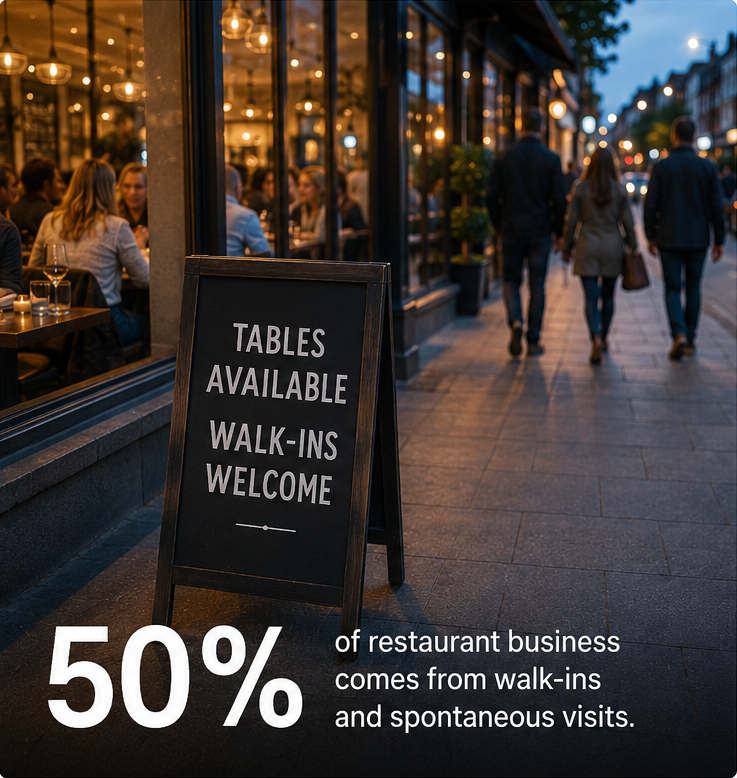
The Opportunity Is Already There: Many restaurants focus heavily on reservations, yet a significant proportion of dining decisions are still made spontaneously. The challenge isn't finding more people who enjoy eating out. It's connecting available tables with nearby diners at the moment they decide where to eat.
- What if restaurants could actively connect with nearby diners at the exact moment they are making a dining decision?
- What if an empty table could become visible to someone who is actively looking for somewhere to eat?
- What if a quiet service period could be transformed into an opportunity rather than a loss?
This is where hospitality begins to move beyond traditional reservation systems. Instead of waiting for customers to discover availability, restaurants can start promoting availability itself. Instead of marketing weeks in advance, they can engage consumers in the moment. Instead of relying solely on bookings, they can generate new visits that otherwise may never have happened.
Most importantly, those previously anonymous walk-ins can become known customers.
A dining decision that once disappeared without a trace can become the beginning of an ongoing relationship. This is where demand generation becomes far more powerful than demand management.
Because the goal isn't simply filling a booking calendar. It's creating additional covers, additional revenue and additional customer relationships that did not previously exist.
ZEZT Is Not A Booking Platform
At first glance, it would be easy to assume ZEZT belongs in the same category as traditional reservation systems. It doesn't.
Booking platforms are designed to manage demand that already exists. A customer decides they want to visit a restaurant, searches for availability and makes a reservation. The platform helps facilitate the booking. It's an important function, but it starts after the customer has already made their decision.
ZEZT approaches the challenge from a different direction.
Rather than focusing solely on managing reservations, the platform is designed to help restaurants generate additional demand.
- To create visits that otherwise may never have happened.
- To connect nearby diners with available tables in real time.
- To transform empty capacity into revenue opportunities.
To help restaurants reach consumers who aren't actively searching for a reservation but may be open to dining out if presented with the right opportunity at the right moment. This distinction matters.
Every restaurant already knows how to manage a booking. The bigger challenge is generating the customer behind it.
Hospitality has spent years refining reservation technology, yet many restaurants still experience quiet periods, unused capacity and unpredictable demand. The missing piece has often been a mechanism for creating additional covers rather than simply organising existing ones.
ZEZT is built around that principle. Not every diner plans weeks in advance. Not every customer begins their journey on a booking platform. Many dining decisions happen spontaneously.
- They happen after work.
- While shopping.
- While travelling.
- While meeting friends.
While walking past a restaurant and deciding that tonight feels like the right night to eat out.
Historically, these opportunities have been difficult for restaurants to influence. Now they don't have to be. By connecting availability with real-time demand, restaurants can begin to capture a much larger share of the spontaneous dining economy.
The result is not simply more bookings. It's more covers. More revenue. More customer relationships. And ultimately, stronger, more resilient hospitality businesses.
Because restaurants don't survive on reservations. They survive on customers.
Conclusion
For years, the hospitality industry has focused on making reservations easier. And to a large extent, it has succeeded. Booking a table today is faster and more convenient than ever before. Yet restaurants continue to face the same challenge they always have: filling empty tables.
The reason is simple. Reservations are only part of the story. A significant proportion of dining decisions are still made spontaneously. Walk-ins, impulse visits and last-minute choices remain a vital source of revenue for restaurants across the country.
Unfortunately, these customers often remain invisible.
- Their data isn't captured.
- Their behaviour isn't understood.
- Their future value isn't realised.
This represents one of the biggest untapped opportunities in hospitality. If restaurants can find better ways to connect with nearby diners, generate demand during quieter periods and convert spontaneous visits into long-term customer relationships, the impact can be substantial.
Sometimes the difference between a difficult month and a profitable one isn't hundreds of additional customers. It's ten extra covers per week.
The hospitality industry has spent decades perfecting how restaurants manage bookings. The next opportunity is helping restaurants generate them.
Because the greatest growth opportunity may not be the customer who books a table three weeks from now. It may be the customer walking past the front door today.
Paul Holmes
Founder: ZEZT
Comments